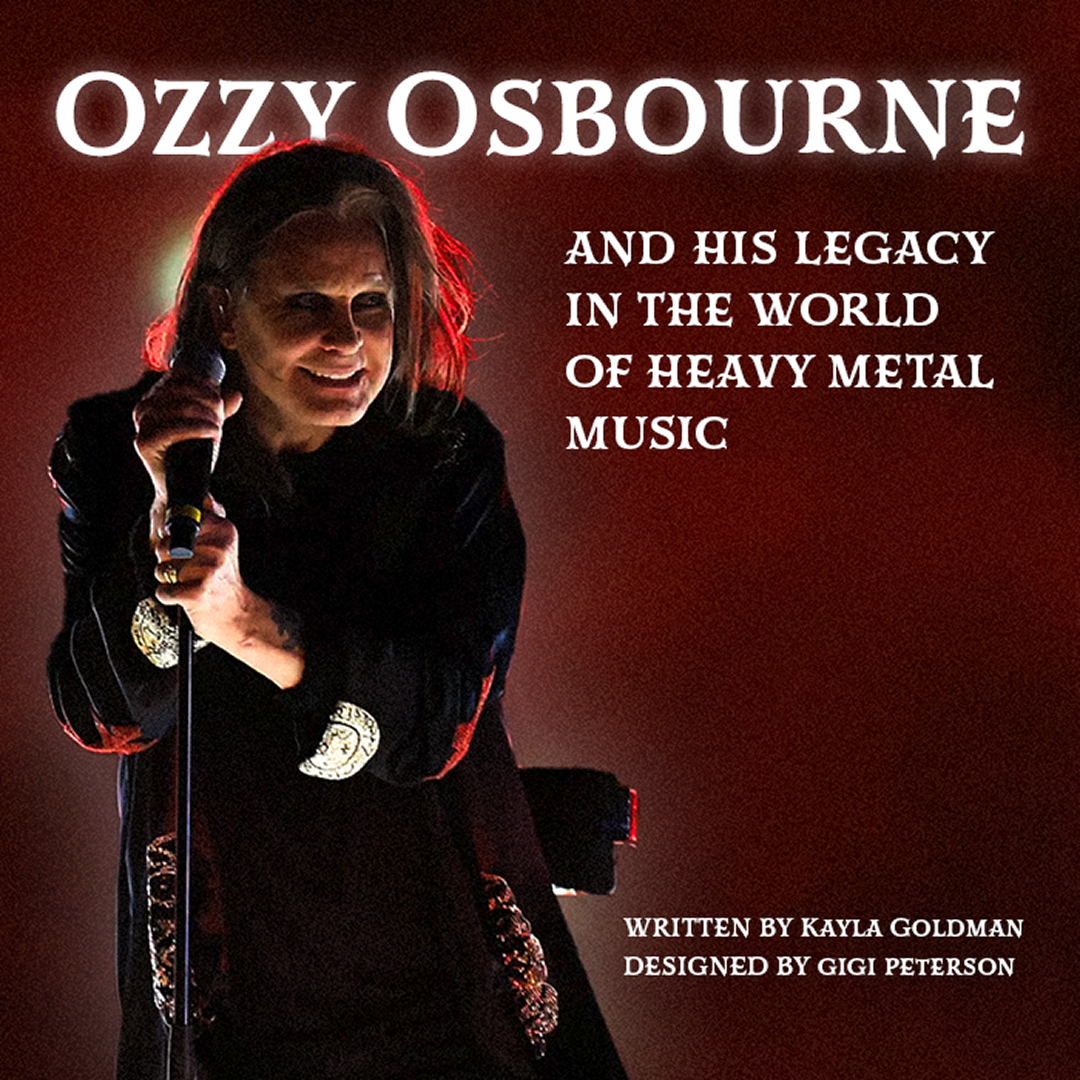
Before Black Sabbath, heavy metal hid in the shadows, but the 1970s band was able to bring the rock genre to life through their hits with lead singer Ozzy Osbourne, better known as “The Prince of Darkness.” Though controversial and known for his crazy antics, Osbourne paved the way for the clashing, rageful music. Though he passed this year, his legend lives on through those who took inspiration from his sound.
He started in the band, the Polka Tulk Blues Band, according to an article by Biography.com, and turned towards heavy metal when they found early success with the genre and its sound. Eventually renamed Black Sabbath, the group consisted of four members: Osbourne, Terrence Butler, Tony Iommi and Bill Ward. In just 9 years, they created eight albums together, quickly rising to fame, but problems arose with Osbourne’s erratic behavior, alcohol and drug abuse. Though they left on relatively good terms and later reunited, Osbourne was kicked out of the band in 1979 by guitarist Tony Iommi, according to People Magazine.
After leaving Black Sabbath, Osbourne then pursued a solo career, opening with his 1980 album “Blizzard of Oz,” a hit that followed the well-known single “Crazy Train,” amongst others. Though his tour in 1981 was canceled due to a tragic plane crash, Osbourne continued his solo career with his first Grammy Award for Best Metal Performance of “I Don’t Want to Change the World.”
The controversies surrounding his wild acts continued as he notoriously bit the head off of a live bat on stage in Iowa in 1982. He had many other newsworthy incidents, most of which were dominated by his drug and alcohol induced state. Fans fell hard for his eccentric actions, a theme that became central for the heavy metal artists who followed in his footsteps. As young artist Yungblud said on “Steve O’s Wild Ride!” podcast,, “‘I’ve been crazy and f**king out there and he was accepted for his madness and he was loved for his madness.’”
Osbourne’s early 2000s addition to his online personality came in the form of his family’s 2002 reality TV show, “The Osbournes,” which starred Osbourne, his wife and manager, Sharon, and two of his children, Jack and Kelly. The show allowed viewers into the Osbourne home, showcasing the inner dynamics within the family. It was seen as very comedic, watching the very loving family curse at each other and dynamically express themselves.
The rest of Osbourne’s music career was characterized by the multiple awards and honors for his solo work and his work with the band, whom he reunited with on multiple occasions. Osbourne’s final musical performance came when he sang at his “Back to the Beginning” charity concert in Birmingham, England, right by his hometown. According to an article written by the New York Times, “Osbourne performed two brief sets: one of his solo music and a second with Black Sabbath.” The appearance marked his first in about seven years, and fans rejoiced in seeing him on stage one last time.
The concert featured a performance by Yungblud, who saw Osbourne as a mentor for his music. The singer-songwriter performed Black Sabbath’s hit “Changes,” as Osbourne sat over him and the crowd, taking it all in. Yungblud’s performance symbolized Osbourne’s desire to pass down his legacy to the up-and-coming artist, and his performance served as an excellent start to his career.
Osbourne passed on July 30, 2025, reportedly suffering from out-of-hospital cardiac arrest, acute myocardial infarction, coronary artery disease and Parkinson’s disease, which he was diagnosed with in 2003. The news of his passing brought fans and celebrities to social media to grieve, including Yungblud, who shared multiple posts in honor of the late singer-songwriter.
“But as it is written with legends, they seem to know the things that we don’t. I will never forget you – you will be in every single note I sing and with me every single time I walk on stage,” wrote Youngblud in an Instagram post, which included a photo of him kneeling in front of Osbourne. .
Osbourne was one of the revolutionary artists of heavy metal music, and his legacy lives on through all of those who took inspiration from his work. As remembered by the New York Times, “Heavy metal acts like Metallica, Slayer and Anthrax have cited him as an influence.” Crazy, wild, erratic and influential — Ozzy Osbourne, “The Prince of Darkness” will live on forever through the soul of heavy metal.”