A promise of action(?)
Forests burning and species’ extinction; warming temperatures and unbearable pollution; ferocious storms and rising sea levels. These are the bleak futures that Greta Thunberg couldn’t shake from her mind back in 2019, when she gave a testimony to the UN at the age of only 16. Born in 2003, Thunberg is a symbol of youth, power, and climate action that Gen-Z students like ourselves grew up with. But where is she now? And what happened to that urgency around climate action?
What has Thunberg been up to?
In 2018,Thunberg spoke at the COP24 United Nations climate change summit (the Conference of Parties, a coalition of countries committed to addressing global climate change. This is where she became famous for calling world leaders immature for not sharing the truth of the climate situation). In 2019,Thunberg spoke at the COP 25 Summit (famous for her ‘how dare you’ moment). After a brief 2 year hiatus thanks to COVID-19, she spoke again at the COP26 summit in 2021 (famous for characterizing talk and no action as ‘blah blah blah’). And finally, since writing The Climate Book in 2022 and speaking of a trip around Europe on boat, Thunberg seems to have disappeared from mainstream media.
You may be wondering what happened to COPs 26-29. Thunberg actually boycotted each of them, citing hypocrisy and greenwashing concerns – for example, Sultan Ahmed al-Jaber, the CEO of Abu Dhabi National Oil Company (Adnoc), was nominated to be the president of the COP28 climate summit. As for COP30, the jury is still out. Regarding what Thunberg has been up to instead, she was recently on a ship bringing humanitarian aid to Gaza, which was seized by Israeli forces and deported back to France, making headlines. So what about the climate clock?
The Climate Clock(s)
The Climate Clock(s) are supposedly a set of clocks counting down to landmark warming thresholds (like 1.5 C, 2.0C, etc.) which mark a significant turning point for climate change (often translating to lives lost or cities/countries submerging). When the Union Square Climate Clock hit zero in 2020, panic spread online — had we already failed? In reality, the clock measures different thresholds depending on the model. While the 1C mark has passed, the 1.5C and 2C deadlines are still ticking. If you haven’t seen the now-famous forecasting climate scientists have done for the Earth in 2100, then you may be in for a shock:
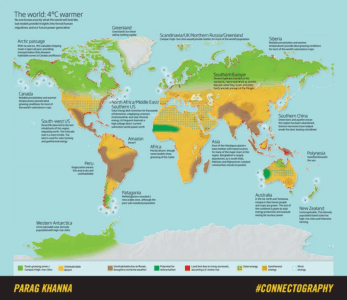
***Hope disclaimer – this is forecasted effects of 4C warming, whereas the current warming has reached 1.2-1.4C.
Most of us will likely remember the morbid threat of the ‘turning point’, the global warming point after which the warming will supposedly spiral out of control. Most climate scientists agree this turning point is between 1.5 and 2C. There are several climate clocks out there, but most agree that this ‘turning-point-clock’ or ‘doomsday-clock’ hits 0 after 2028.
So why are there so many other climate clocks that people have made that seem to have already hit 0? The reality is that climate disruption is already underway. It may seem like we’re racing against new countdowns, but that’s largely due to shifting ‘net-zero’ deadlines and outdated rhetoric. Back in the 1980s and 1990s, the message was, “If we act now, we can prevent major climate disruption.” Today, it’s become, “If we act now, we can slow the damage that’s already unfolding.
So what does this mean for us as average everyday citizens of the world? Well, the greenhouse gases that have accumulated in the atmosphere are already trapping more than 90% of the thermal radiation on Earth from escaping to space -– the effects won’t be fully felt until the next 50-100 years, kind of like a thermal battery. This means that adding any more emissions will only compound the impact and speed up that time-to-impact. So yes, there are several climate clocks ticking — the one for 1C warming has already hit zero, but the ones for 1.5C, 2C, 3C, and 4C are still ticking. One study estimated that if warming is limited to 1.5 °C rather than 3 °C, then in New York City alone ~2,716 heat-related deaths/year would be prevented.
What the science says
At this point, climate change isn’t some future scenario — it’s happening in real time. According to the World Meteorological Organization (WMO), the past nine years have been the hottest ever recorded, and 2023 briefly crossed the 1.5C threshold above pre-industrial levels. That number isn’t random — it’s what climate scientists call a “tipping point,” where small shifts start triggering massive, irreversible changes. Think: collapsing coral reefs, melting ice sheets, cities struggling under deadly heat.
If emissions keep going the way they are, the Intergovernmental Panel on Climate Change (IPCC) projects roughly 2.7 °C of warming by the end of the century under current policies. That may not sound like much on paper, but it translates to more than hotter summers – it means rising seas, food insecurity, climate-driven migration, and extreme weather becoming, well, the new normal. And we’re already seeing it: 2023 set records for wildfires in Canada and Hawaii, and the U.S. alone experienced over 25 billion-dollar weather disasters. Every tenth of a degree matters now. Every fraction we can slow down means fewer lives lost, fewer communities displaced, fewer ecosystems erased.
If/when you should get involved
The best time to care was decades ago. The second-best time is right now.
Getting involved doesn’t mean becoming a full-time activist – it means refusing to look away. It’s asking questions about where your food comes from, how your city powers its lights, or why your university still invests in fossil fuels. Curiosity is activism, too. Change doesn’t always look like grand speeches or protests – sometimes it’s the quiet stuff: biking instead of driving, voting for local green initiatives, reducing food waste, supporting sustainable brands, doing research in sustainability or even starting conversations that make people think twice. At Northeastern, 20% of students are involved in sustainable activities in some way according to the Sustainability Literacy and Cultural Assessment. That means 80% of students are waiting to be inspired. The same survey found that 46% of students think their peers care very much about sustainability, while in reality, 73% stated that they cared very much, almost a 30% gap. More people care than you think, and you can check out the NU Sustainability Family Tree Notion page right now to find a club niche or time that fits you, and start advocating for climate justice.
But the bigger picture matters too. Corporations and governments hold most of the power, which means holding them accountable matters more than perfect personal habits. Every time you vote, sign, post, or question, you’re part of the ripple effect. So pay attention to climate policy when candidates claim to fight for you. Just because our glass of water spilled doesn’t mean we let it keep spilling. We can catch it mid-fall, mop up what’s left, and build a sturdier table next time. That’s what this moment calls for – not despair, but design. Greta Thunberg was 16. Now she’s 23. When she turns 30 along with the rest of us, we’ll share responsibility for the state of the world – let’s make sure we give it our all.